Online Laboratory for 100% Production Monitoring
LabPack extends yarn quality control beyond periodic laboratory sampling to continuous online monitoring.
Instead of evaluating only selected samples, LabPack measures 100% of the produced yarn directly during
winding and provides real-time quality data.
Powered by the latest YarnMaster® PRISMA technology, LabPack continuously monitors key yarn
characteristics such as CVd, Hairiness and Imperfections, enabling faster process optimisation, improved
quality consistency and reliable identification of off-standard bobbins.
PRISMA LabPack offers:
- Consistent yarn quality thanks to online monitoring of every millimetre of yarn
- Immediate production optimisation with real-time quality insights
- Reliable identification of off-standard bobbins before they enter subsequent processing steps
- Greater transparency of raw materials and machine performance across the spinning process
- Reduced laboratory workload through fewer manual sampling and testing activities
- Early indication of ring traveller and machine component wear through changes in yarn quality trends
LabPack Features and Quality Values
PRISMA LabPack combines dedicated unevenness and hairiness clearing and monitoring functionality with
proven quality values.
LabPack clearing & monitoring:
- VCV: Variable Coefficient of Variation
- Hairiness
LabPack quality values:
- CVd: Coefficient of Variation of diameter
- Hairiness
- IPI: Imperfections
LabPack Clearing & Monitoring
VCV: Early Detection of Process Variations
The VCV (Variable Coefficient of Variation) function enables reliable detection of abnormal diameter variations caused by drafting errors, top or bottom roller eccentricities, machine disturbances, or localised process irregularities. The realtime detection of disturbances, allows spinning mills to quickly pinpoint process issues and maintain consistent yarn quality throughout production.
Advantages for yarn production
- Early detection of drafting or roller problems
- Identification of sporadic defects
- Improved yarn quality through targeted removal of defective yarn sections
- Efficient process monitoring thanks to adjustable sensitivity in measurement
- Accurate detection of missing slub and irregular slub pattern in slub yarn
Flexible Inspection Lengths for Better Process Visibility
Unlike conventional laboratory testing, where CV values are typically calculated over fixed lengths of 400m or 1000m, VCV allows inspection lengths to be tailored to the process and application.
- Cuts: 1m to 50m
- Events: 10m to 1000m
This flexibility enables the detection of short-duration process disturbances that may be averaged out in laboratory results. As a result, spinning mills gain earlier visibility of developing quality issues and can take corrective action immediately.
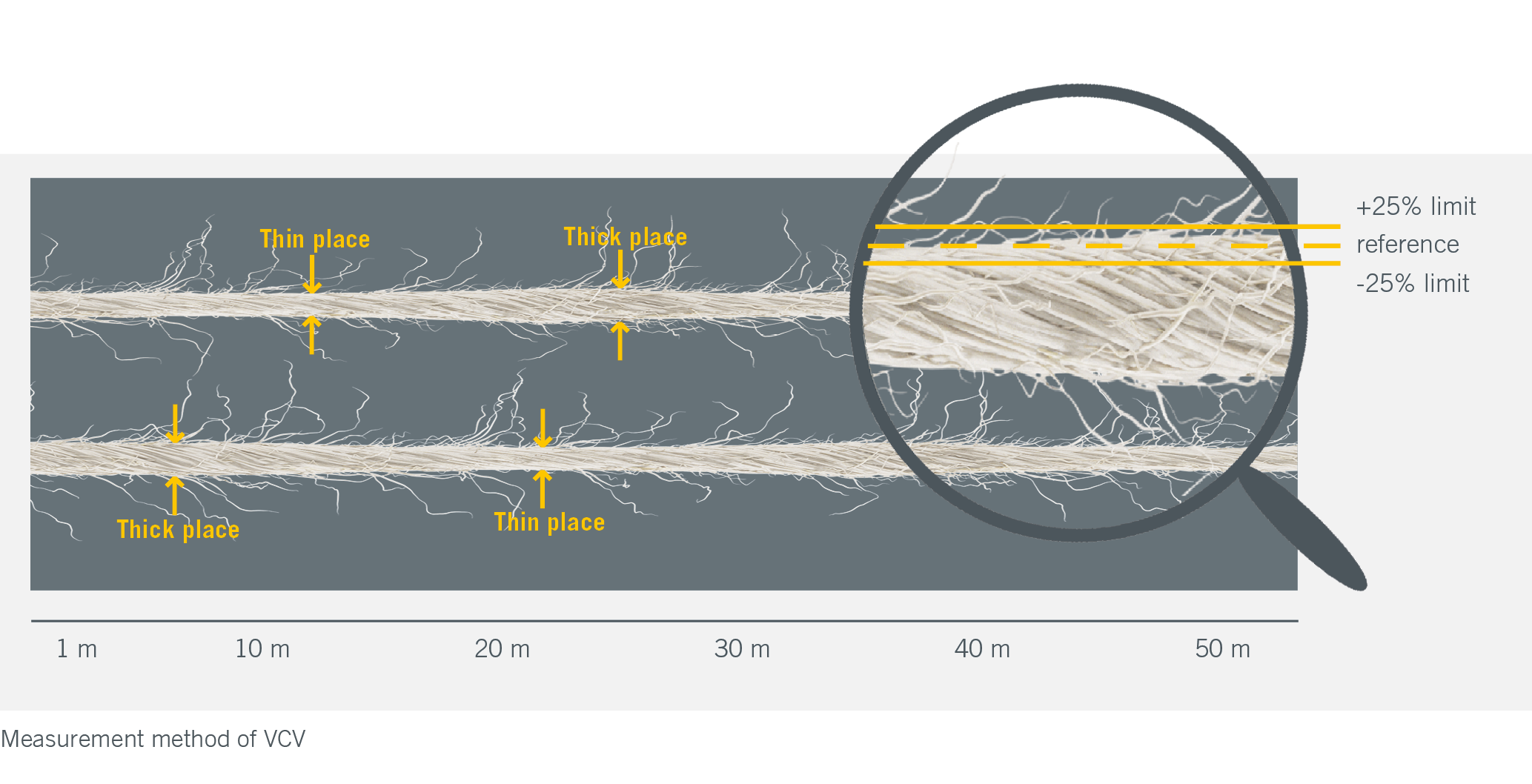
Measurement method of VCV
VCV Cuts
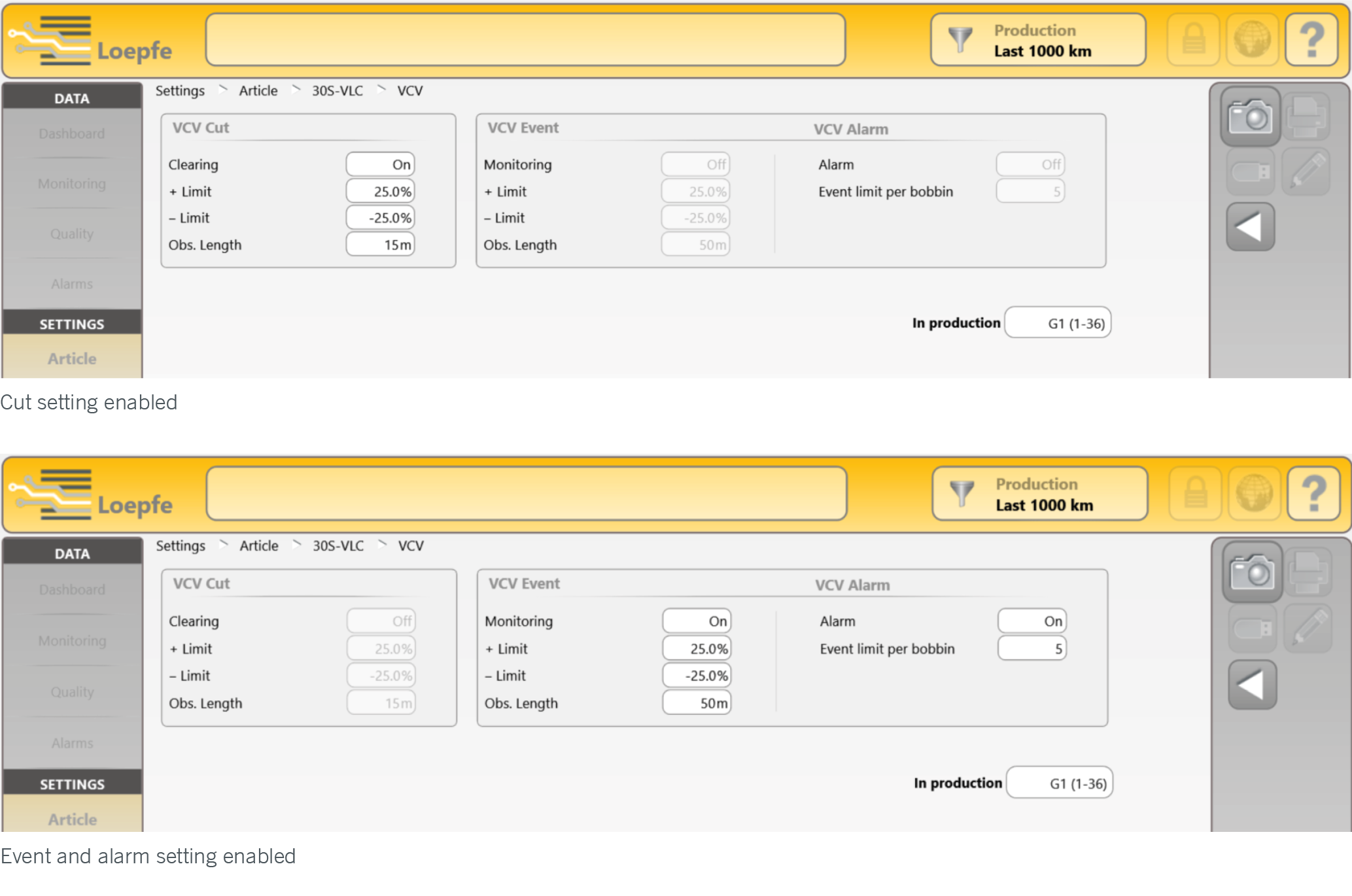
Based on the yarn data collected by the yarn clearer, a CV value (Coefficient of Variation) is continuously calculated. This value is compared in real time with a reference for the respective yarn group (VCV group reference). As soon as the set tolerance limit is exceeded or fallen below, an automatic cut is triggered. The winding unit will remove the set observation length.
VCV Events / Alarms
Rather than triggering an immediate cut, VCV events can be recorded when the defined threshold is exceeded. The system monitors VCV events per bobbin over inspection lengths ranging from 10 to 1000 metres, with a configurable event limit for each bobbin. In addition the winding position can be alarmed and stopped, allowing the particular bobbin to be removed. The key advantage is that only deviations likely to affect downstream processes are counted.
Event and alarm setting enabled
Hairiness: Monitoring Yarn Surface Quality
Depending on the spinning process and end application, a certain degree of yarn hairiness is desirable and may even be necessary. Excessive or uneven hairiness can lead to significant quality and processing problems. By continuously measuring and controlling hairiness, spinning mills secure an essential part of quality assurance in yarn production.
Advantages for yarn production
- Maintaining a uniform yarn surface
- Improved weaving and knitting performance by reducing disruptions caused by yarn entanglement and abrasion
- Enhanced operational reliability, even on high-speed textile machines
- More consistent dyeing results
- Reduced pilling tendency, contributing to higher-quality finished products
- Improved fabric appearance and feel
Flexible inspection lengths for targeted Hairiness Monitoring
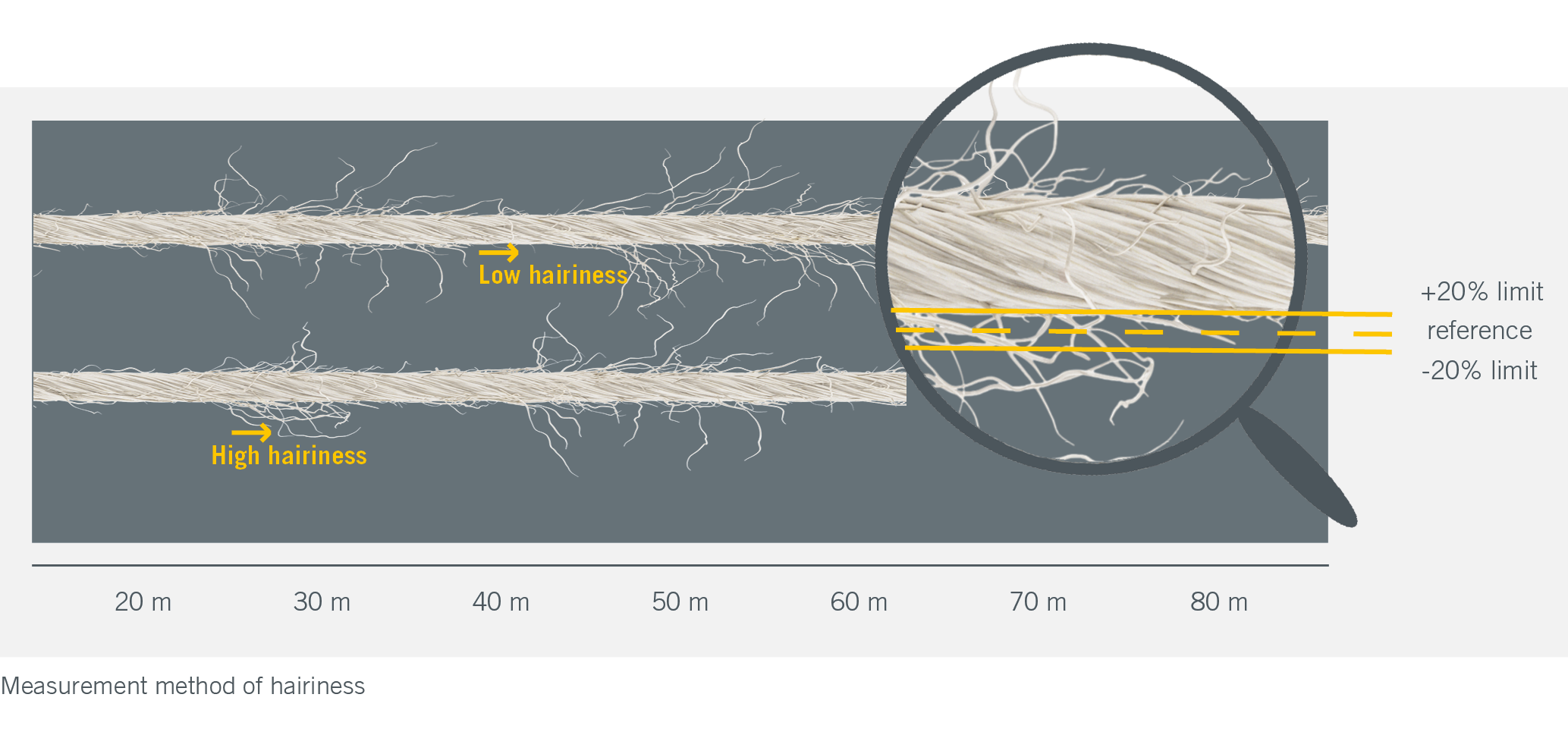
By continuously monitoring and controlling hairiness, a consistently uniform yarn surface is ensured. Compared with conventional laboratory testing, a key advantage is the ability to select inspection lengths that match the process requirements.
- Cuts: 20 m to 80 m
- Events: 20 m to 1000 m
Hairiness control directly contributes to stable production, reduced waste, and increased customer satisfaction across the textile value chain.
Measurement method of hairiness
Hairiness Response Functions
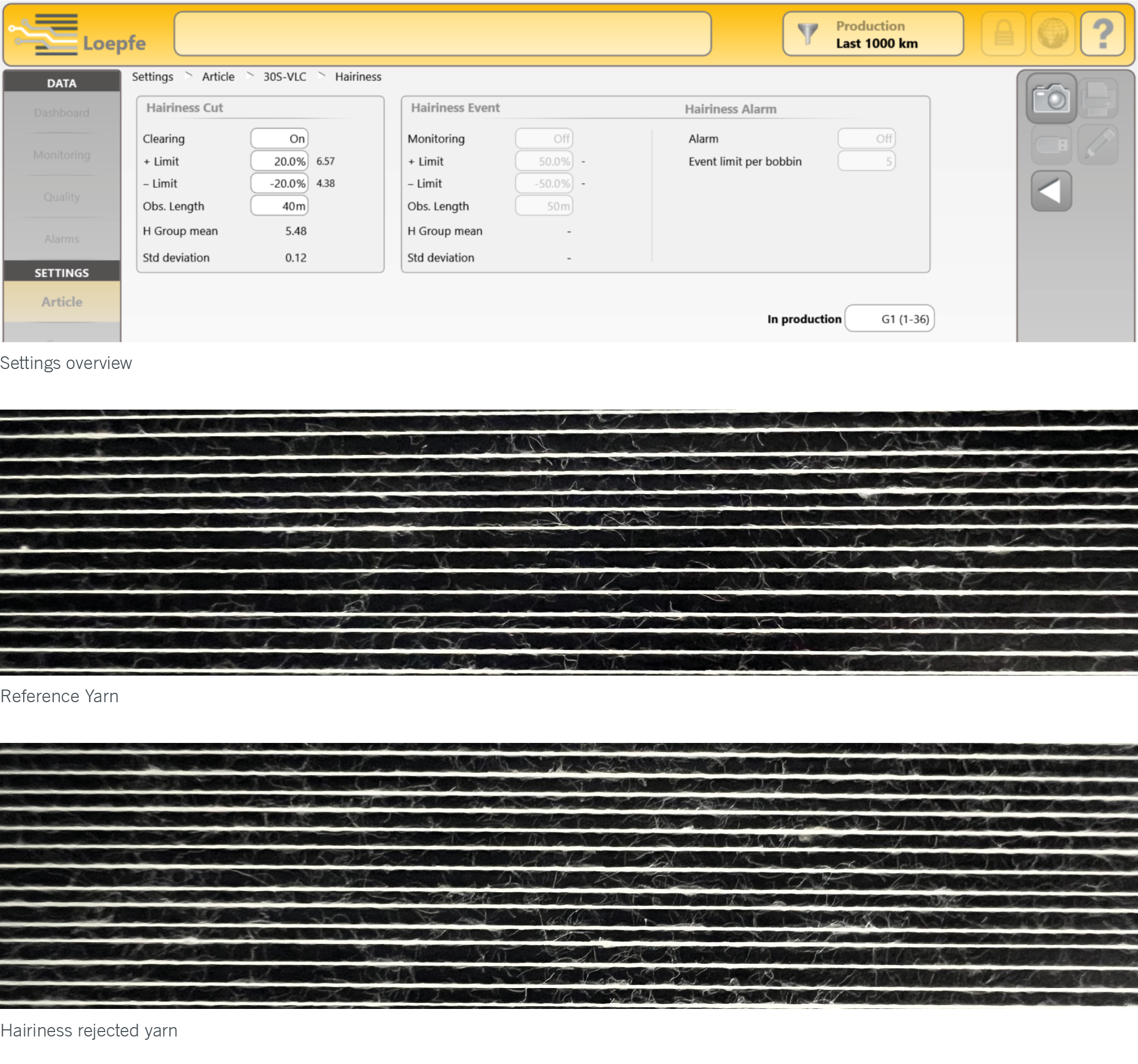
In the settings overview, hairiness can be specifically selected and monitored. Different response options allow quality requirements to be adapted to individual customer and application needs. Hairiness cut, hairiness event and hairiness alarm ensure reliable quality control throughout the entire yarn production process. The H Group mean value is shown on the settings page, along with the detection range for hairiness, which is defined based on the configured limit.
LabPack Quality Values
CVd:
The coefficient of variation (CV) is one of the most widely used indicators for assessing the evenness of yarns and is displayed in the quality overview.
Unlike offline laboratory measurements based on selected samples, CVd is calculated from continuously collected production data, providing real-time insight into yarn evenness and earlier visibility of developing process trends.
Measurement and interpretation
The uniformity of yarn diameter variations is determined using optical measurement technology.
- Low variation means a low CVd value. In this case, all packages in a batch have similar evenness, indicating uniform and homogeneous production.
High diameter variation results in a higher CVd value. Quality variation between packages increases, indicating reduced process stability and a higher risk of downstream quality issues.
Hairiness:
Hairiness describes the fibres protruding from the yarn and is measured over a length of 1cm. The hairiness value provides a precise indication of the yarn’s surface structure and has a direct influence on weaving, knitting, dyeing, pilling behaviour, and the appearance of the finished fabric. By continuously monitoring hairiness online, LabPack helps spinning mills maintain a uniform yarn surface and consistently high yarn quality.
Measurement method and interpretation
The measurement is performed using special infrared signals that evaluate all protruding fibres within the set observation length by using a dedicated algorithm.
The obtained values enable:
- Clear comparability between yarn batches
- Early detection of deviations in the spinning process
Targeted process optimisation, for example, by adjusting the twist or spinning parameters
IPI:
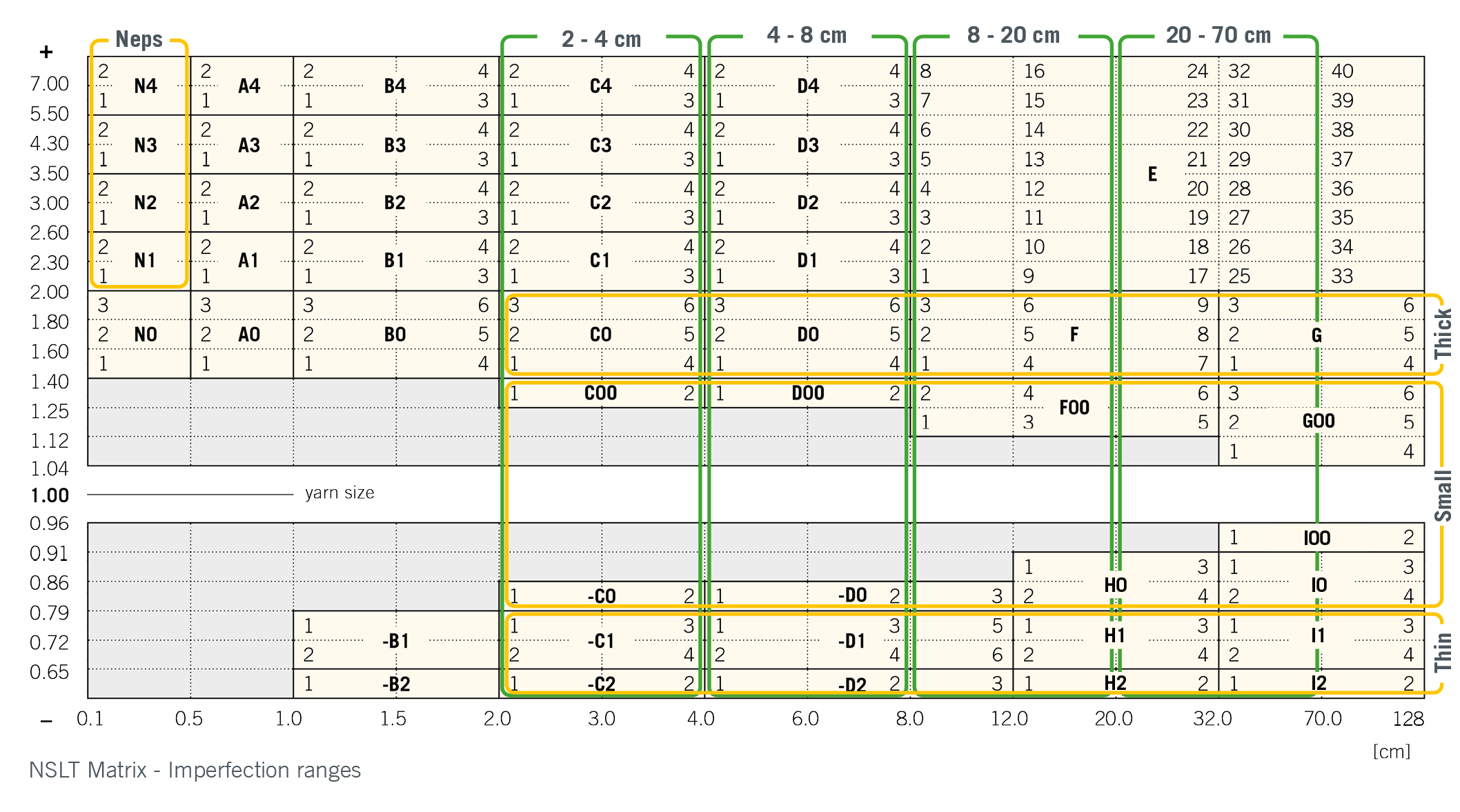
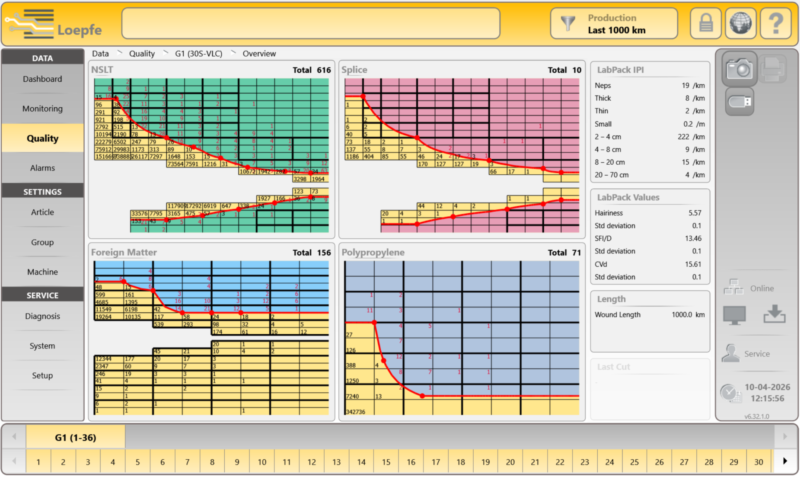
PRISMA continuously measures and classifies yarn imperfections, providing a complete picture of yarn quality during production. In addition to the detection of neps, thick places, and thin places, PRISMA also identifies longer diameter deviations, such as periodic faults and extended thick or thin places. This allows spinning mills to detect both isolated defects and systematic process problems at an early stage.
Measurement method and interpretation
The system provides the following key values per 1000 meters of yarn:
- Neps
- Thick places
- Thin places
- Small (Irregularities per 1 metre)
- Length 2 - 4 cm
- Length 4 - 8 cm
- Length 8 - 20 cm
- Length 20 - 70 cm
These measurements offer direct insight into the uniformity and quality of the yarn.